
Moonshot Goal 4
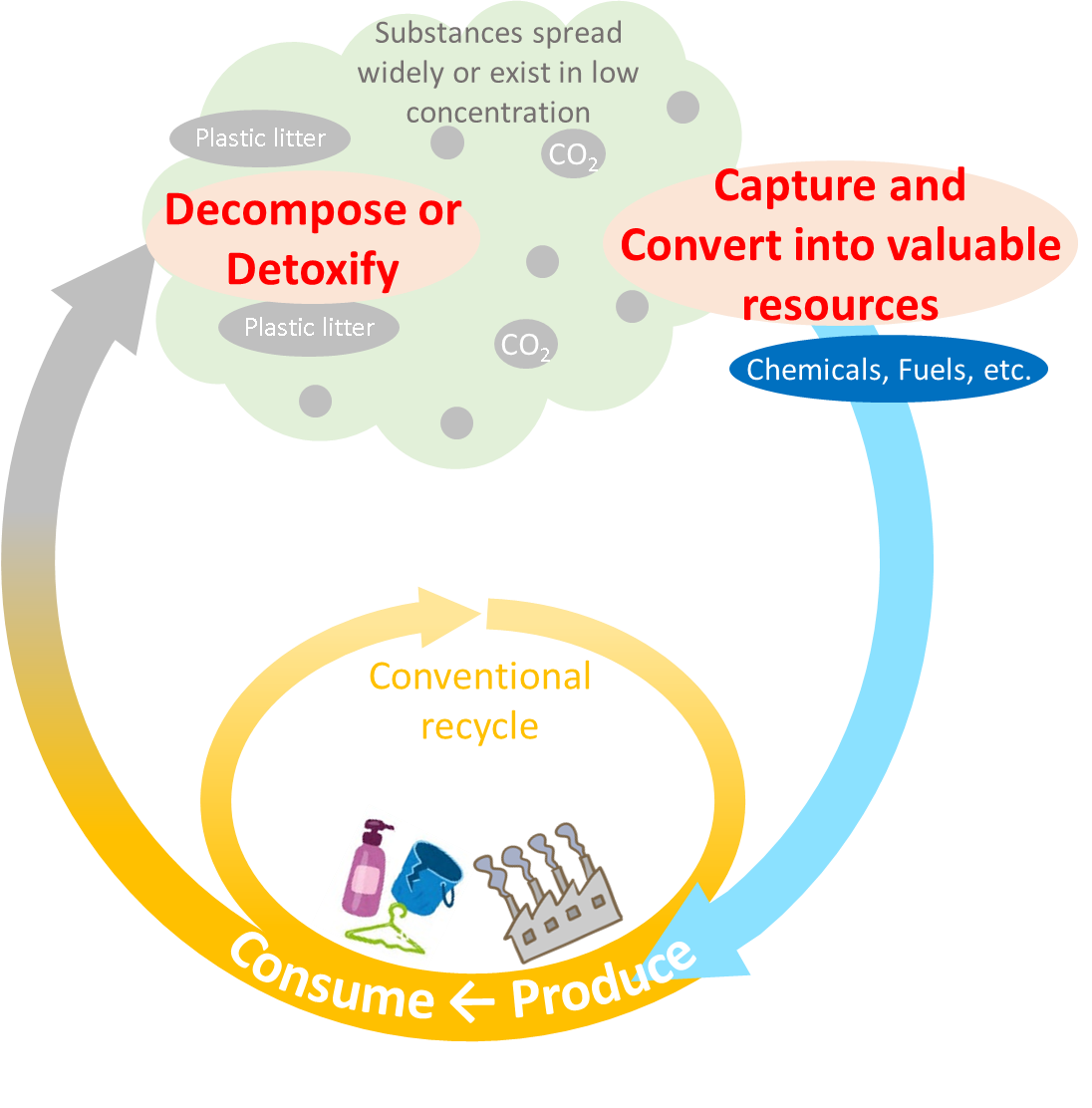
Realization of sustainable resource circulation to recover the global environment by 2050.
Target of Moonshot Goal
Solutions to the global warming problem (the Cool Earth) and environmental pollution problem (the Clean Earth) through realization of sustainable resource circulation for the global environment.
Cool Earth and Clean Earth
- Global deployment of commercial plants or products utilizing circulation technology by 2050.
Cool Earth
- Development of circulation technology on a pilot scale for reducing greenhouse gases that is also effective in terms of life cycle assessment (LCA) by 2030.
Clean Earth
- Development of technology on a pilot scale or in a form of prototype that converts environmentally harmful substances into valuable or harmless materials by 2030.
Reference

R&D Projects
PD: YAMAJI Kenji (President of the Research Institute of Innovative Technology for the Earth (RITE))
(1) Development of technologies to recover greenhouse gases ("GHGs") and convert them into valuable materials
| PM | R&D Project |
|---|---|
| KODAMA Akio
Kanazawa University |
Development of highly efficient direct air capture (DAC) and carbon recycling technologies |
| SUGIYAMA Masakazu
The University of Tokyo |
Integrated Electrochemical Systems for Large-Scale CO2 Recycling |
| NORINAGA Koyo
Nagoya University |
Research and Development on Direct Air Capture With Available Cold Energy |
| FUJIKAWA Shigenori
Kyushu University |
Development of a CO2 Recycling System for a Beyond-Zero Society |
| YAMAZOE Seiji
Tokyo Metropolitan University |
Research and Development of Passive DAC Technologies |
| UEDA Mitsuyoshi
Kyoto University |
Redesign of macroalgae for highly efficient CO2 fixation by functional modifications and their product generation |
| NAKAGAKI Takao
Waseda University |
A-ERW Combines Technology and Site Characteristics |
| MINAMISAWA Kiwamu
Tohoku University |
Mitigation of Greenhouse Gas Emission from Agricultural Lands by Optimizing Nitrogen and Carbon Cycles |
(2) Development of technologies to recover nitrogen compounds and convert them into harmless or useful materials
| PM | R&D Project |
|---|---|
| KAWAMOTO Tohru
National Institute of Advanced Industrial Science and Technology (AIST) |
Nitrogen Recycling Technology Can Keep Us Within Our Planetary Boundary |
(3) Development of marine biodegradable plastics which can control the timing and speed of their degradability
| PM | R&D Project |
|---|---|
| ITO Kohzo
The University of Tokyo |
Multi-Lock Biopolymers Made From Biomass Break Down in the Ocean |
| KASUYA Ken-ichi
Gunma University |
Research and Development into Marine Biodegradable Plastics With a Degradation Initiation Switch |